Market Winds and ProbabilitiesData Reliability and ObfuscationUnited States
US funds' holdings of 16 tracked Chinese military stocks rose $164 million
Data through July 2026
Exhibit 1
How to cite this exhibit
# Jon Ferrin. “US funds' holdings of 16 tracked Chinese military stocks rose $164 million,” Exhibit 1. Tres Haciendas Analytics, November 2026. https://treshaciendasanalytics.com/analysis/treasury-chinese-military-list-fund-holdings/#fig-treasury-chinese-military-list-fund-holdings
16 primary sources · 6 issuers · 12 notes
- Primary sources
- 16
- Issuers
- 6
- Notes
- 12
Every source is held with its SHA-256 hash and a screenshot of the cited words; 9 as a saved text capture rather than the published original.
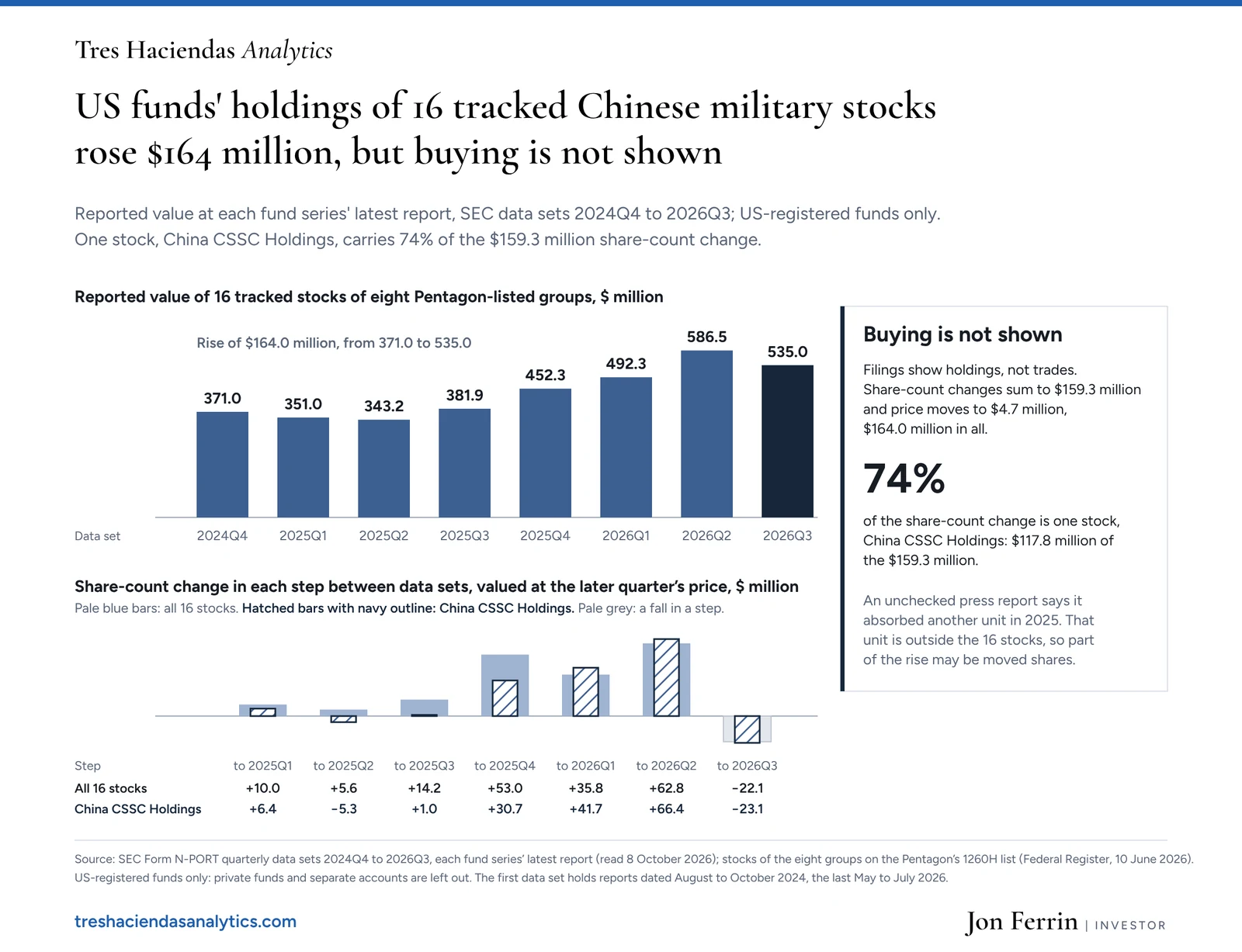
US funds' holdings of 16 tracked stocks of eight Pentagon-listed groups rose $164 million since the third quarter of 2024,1 but buying is not shown.2 Treasury names 1 of the 16 stocks3 and bars buying it and, after one year, selling it, but allows holding it.4 SEC-reporting funds held $535 million in them in mid-2026, $534 million of it in shares.3 Share-count changes sum to $159 million and price moves to $5 million, but filings show holdings, not trades.1
- China CSSC Holdings accounts for $118 million of the $159 million, 74%.5 An unchecked press report says it absorbed unit 601989 in 2025; that unit is outside the 16, so the rise may include moved shares.3 Broad funds, meaning neither China nor theme funds by name, accounted for about 93% of the $159 million.6
- Vanguard funds and BlackRock's iShares funds owned 64% of the $535 million.7 In the four largest funds, these stocks were under 0.1% of net assets.8 The median fund owning them kept about $37 of them per $100,000 of assets.9
- About $48,000 of the $535 million sits in the one stock on Treasury's list, which governs securities trades.3 It covers only exact names and reaches a subsidiary only if that subsidiary is itself listed.10 The Pentagon's 1260H list is different: it limits the Defense Department's own contracts.11
A screen built only on Treasury's list, which names 1 of the 16 stocks,3can pass funds that own the other 15. Borrowed Time, the window in which a shortfall builds into lasting damage,fits this case weakly. A Tear, an event that permanently alters a system,would be a forced sale, and none is shown. That holds only while Treasury lets holders keep their shares.
- Wait, the restraint that holds a commitment back until capacity exists,cannot be tested, since filings show holdings, not motives. No spentbuffer, the cushion that covers a shortfall,is shown. A Tear counts as Borrowed Time only when a spent buffer came before it.
- The strongest alternative is a corporate action, not buying, at China CSSC Holdings, the source of 74% of the change.5 If the press report holds, the swap ratio times each fund's 601989 shares is the part of the rise that is not buying.5 Any 600150 rise above that is what remains for buying; the records hold neither input.5
- In a listed stock's first year, a larger share of its earlier positions falling or ending than in any past quarter would count against buying. For 600372, whose window ended in 2022, a sale is barred, so a fall would not be a market signal.34 Share counts fell by about $22 million last quarter, valued at the later price,12so a second fall would turn the trend down.