Demographic FlowsBorrowed TimeJapan
Japan's birth-support charge cannot add parents who were never born
Exhibit 1
How to cite this exhibit
# Jon Ferrin. “Japan's birth-support charge cannot add parents who were never born,” Exhibit 1. Tres Haciendas Analytics, November 2026. https://treshaciendasanalytics.com/analysis/japan-birthrate-below-replacement/#fig-japan-birthrate-below-replacement
10 primary sources · 5 issuers · 22 notes
- Primary sources
- 10
- Issuers
- 5
- Notes
- 22
Every source is held as published, with its SHA-256 hash and a screenshot of the cited words.
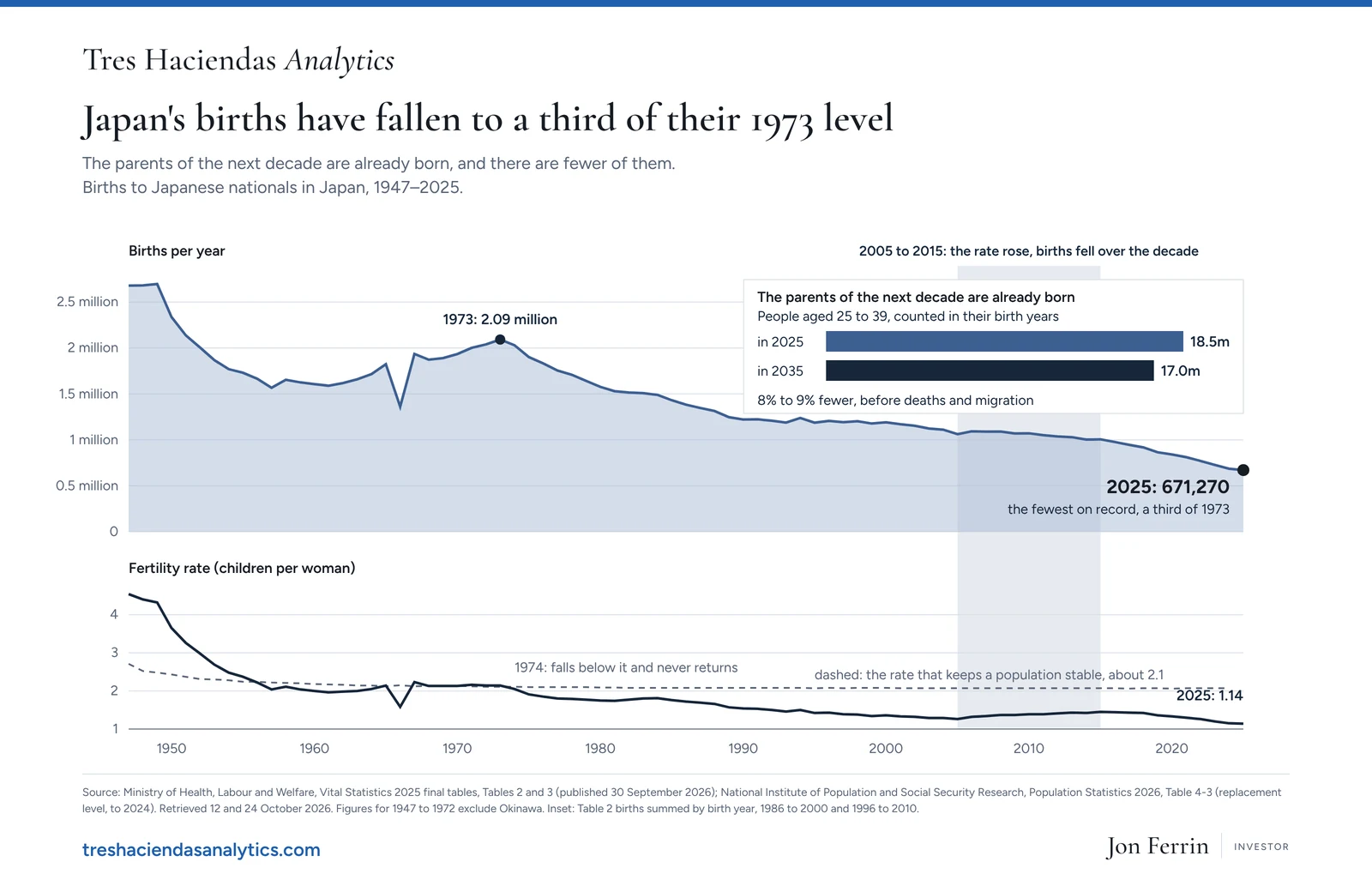
Yes, births are likely to keep falling into the mid-2030s,12 even though Japan now adds a charge to public health insurance premiums to help fund a push for more births.3 Births to Japanese nationals hit a record low of 671,270 in 2025.1 The charge began in April 2026.3 For employees it is a combined 0.23% of insured monthly pay, of which the employee's own share is usually half, for a plan that sets no numeric birth target.4 The government calls the years before the 2030s, when the young population falls sharply, its last chance to reverse the decline.5
- Births and the fertility rate have fallen together for ten straight years.6 The rate, the number of children a woman would have over her life at that year's birth rates, is 1.14, the lowest on record.7
- When the plan is complete in FY2028, its new support for families with children reaches about ¥3.6 trillion (the government's summary gives no period for the figure), almost half of it financial help for families, which includes expanded child allowances.8 The plan counts on the new charge, set according to each payer's ability to pay, for about ¥1.0 trillion of that;9 the government says spending reform and wage gains offset it.10
- The Children's Future Strategy, the document that sets out the plan, sets no numeric target for births or the fertility rate.11 Its numeric targets include fathers' parental leave, 85% in private firms by 2030.11 Births and the rate have fallen in both years since its adoption in December 2023,12 too short a time to judge it.
The next decade's parents are already born, and there are fewer of them.2 A rough pooled estimate, counting each generation at birth and leaving out deaths and migration, puts the rate needed to keep 2035 births at their 2025 level, the break-even, at 1.24 to 1.25;13 the 2025 rate was 1.14, below the break-even.7 Births depend on both the rate and the size of the parent generation, which the children born in earlier years set, so a rising rate alone does not mean more births. The generation that will be 25 to 39 in 2035 was 8% to 9% smaller at birth than the generation aged 25 to 39 in 2025.2
- The call hangs on an assumption: that the timing of births by mothers' age and the survival of young women stay near their recent pattern, as the pooled estimate also assumes. A sharp shift of births to older ages would move the break-even by an amount this estimate does not compute.
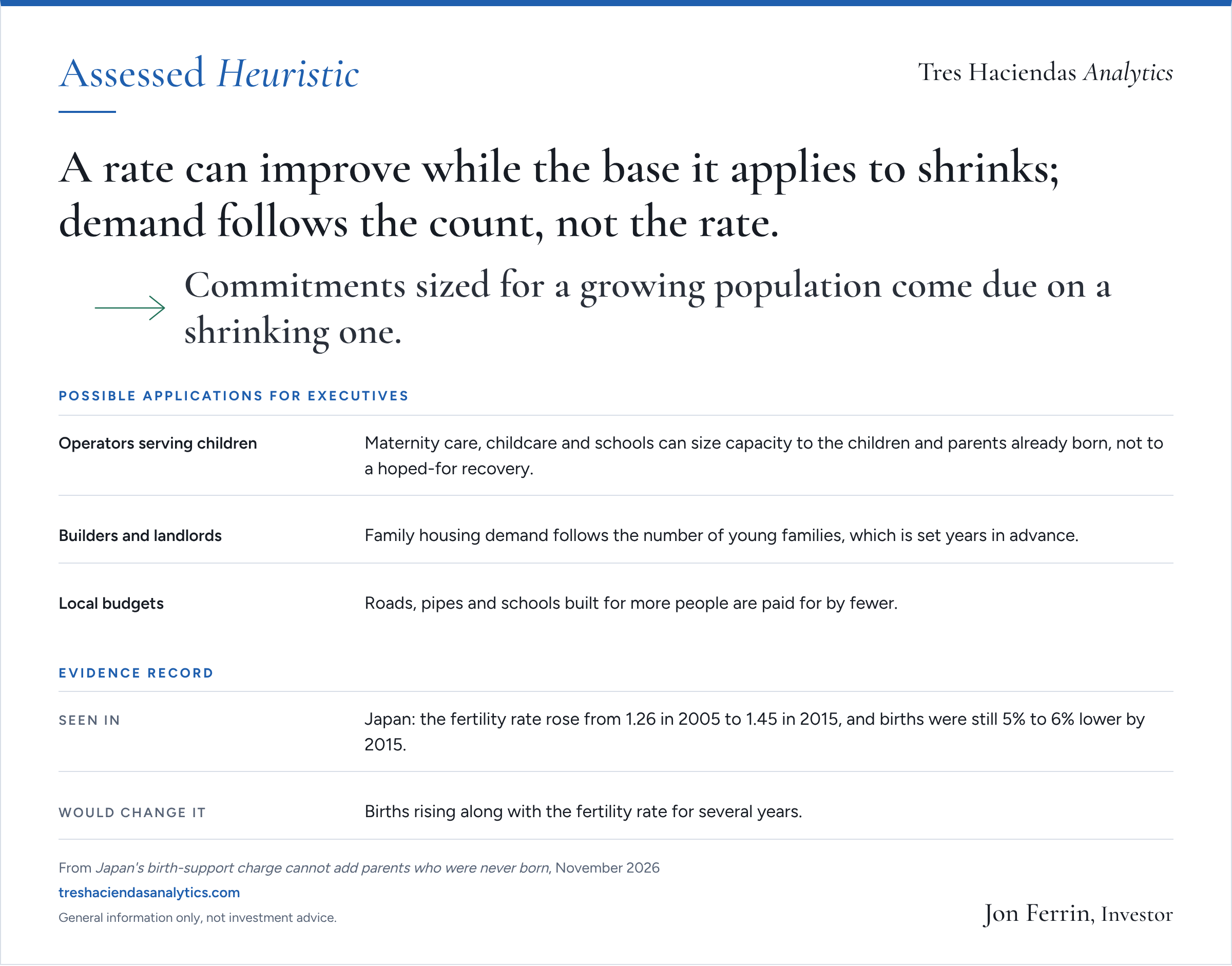
- When the rate rose 14% to 16% from 2005 to 2015,14 births were still lower in 2015 than in 2005.15 Counted at birth, the generation aged 25 to 39 was 18% to 19% smaller in 2015 than in 2005,16 which is consistent with births falling while the rate rose. The record stays: a rebound in the rate does not bring back the cohorts that were never born.
- If the rate holds at its 2025 level, births to foreign parents in Japan would need to triple or quadruple to make up the 2035 shortfall in births.17 In 2025 they added 3% to 4% to Japanese nationals' births.18
Japan's fertility rate has been too low to keep its population stable for half a century,19 and births in 2025 were about a third of their 1973 level.1 This is Borrowed Time: the stress that builds when a society carries more than it can realistically sustain, until it gives way. With the new charge, employers and their staff now help pay for the response to that long shortfall in births. Any commitment still sized to the large generations born in the early 1970s, such as a maternity ward or, in time, a school, now serves generations a third their size at birth, so new capacity should follow the cohorts already born, not a hoped-for recovery.120
- The large generation born in the early 1970s most likely hid the shortfall in births.20 As it reached childbearing age, births held near 1.2 million a year through the 1990s, even as the rate fell.21 It is now in its fifties.20
- The strongest other case is a rebound in the rate of about 9% to 10%, well short of the 14% to 16% rise from 2005 to 2015, which would clear the break-even.131422 That is less likely than not within ten years: the rate and births have fallen ten years in a row and no record here shows the plan or its charge lifting the rate, though the rate did turn up after its 2005 low.622 Confidence is moderate, because the call rests on one birth count with migration outside it.
- The next tests are the health ministry's 2026 figures: a preliminary edition first, then the final tables, due around September 2027.7 A 2026 rate at or above 1.24 with births rising would weaken this view; a rate at or below 1.14 with births falling again would support it.137
Download the cardThe card with its full evidence trail →Download the evidence pack