Data Reliability and ObfuscationMarket Winds and ProbabilitiesChina
Two Chinese aircraft makers' advances fell to 1.1 months
Data through June 2026
Exhibit 1
How to cite this exhibit
# Jon Ferrin. “Two Chinese aircraft makers' advances fell to 1.1 months,” Exhibit 1. Tres Haciendas Analytics, November 2026. https://treshaciendasanalytics.com/analysis/china-aircraft-makers-customer-advances/#fig-china-aircraft-makers-customer-advances
18 primary sources · 2 issuers · 6 notes
- Primary sources
- 18
- Issuers
- 2
- Notes
- 6
Every source is held as published, with its SHA-256 hash and a screenshot of the cited words.
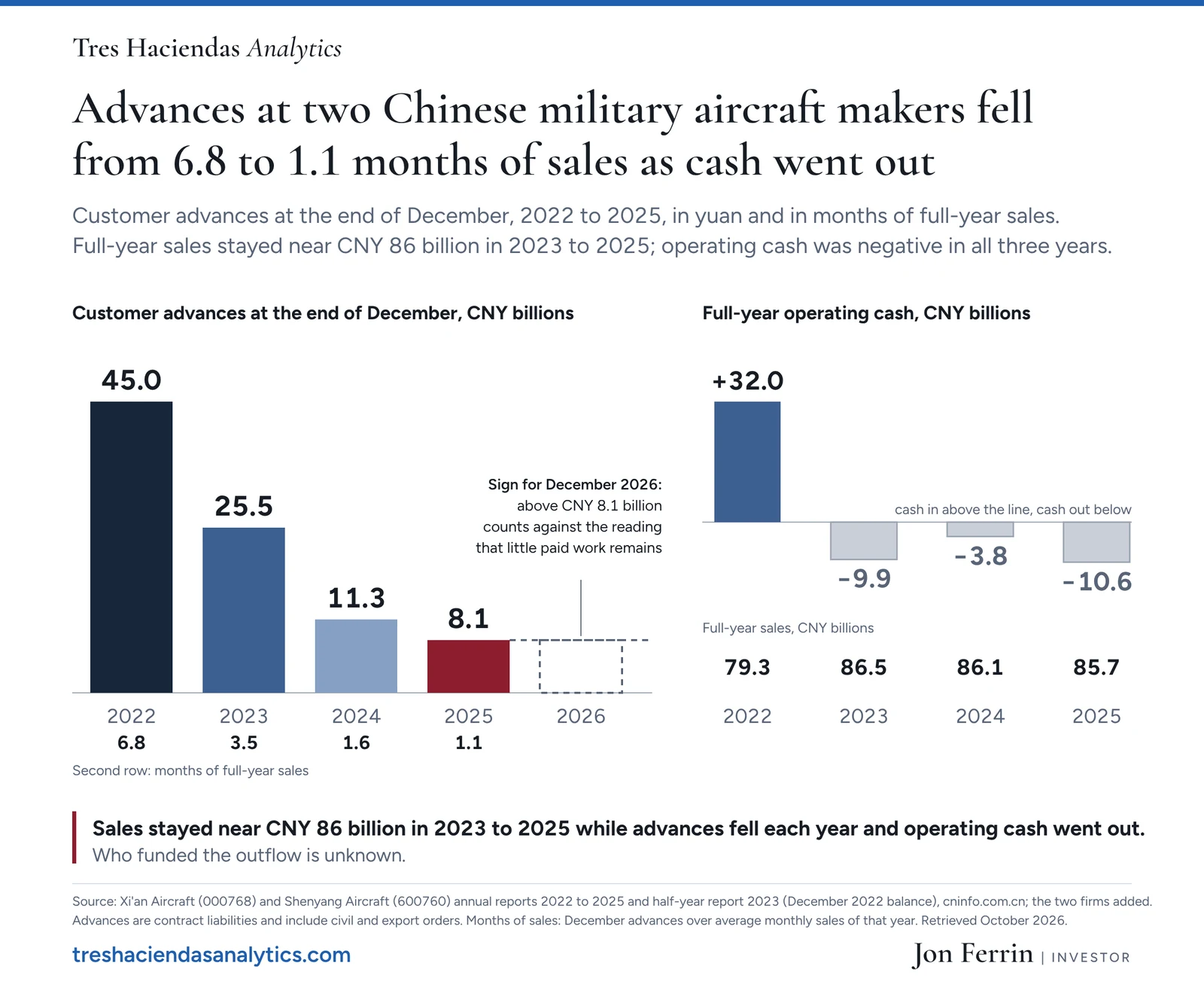
Yes: advances at two Chinese military aircraft makers fell from 6.8 to 1.1 months of sales, 2022 to 2025, as cash went out.1 First-half 2026 sales fell about 40% on 2025, so check advances and cash; whether advances carried sales, and who paid, is unproved.2 Customer advances are payments received, or owed, for goods not yet delivered.3 The Borrowed Time test asks whether advances were a buffer, a reserve that carried sales and now leaves little work already paid for.
- Full-year sales were near CNY 86 billion in 2023 to 2025, while December advances fell each year.1 Full-year operating cash, the cash from running the business, was negative in all three years.1
- On a first-half basis, cash went out from 2023, before sales slipped in 2024 and fell sharply in 2025.45 If goods delivered against advances already paid add sales but no new cash, sales can stay level while cash goes out. Full-year sales for 2025 stayed level, with the first half a smaller share of the year.1
- Wait, the restraint that holds a commitment back until capacity to carry it exists, is not shown to be disregarded. The figures cover sales, operating cash and advances, so they hold no delivery schedules or capacity data.
The buffer reading fits the figures, but a Tear for suppliers or lenders is not shown. A Tear is a break after which a system cannot return to its earlier state. A financing move, such as later payment or new borrowing, is not by itself a Tear.
- December 2026 advances above CNY 8.1 billion would suggest orders or payments, which counts against the reading that little paid work remains.1 A fall in full-year 2026 sales alone does not separate the readings, as the first half was already 40% lower.62 Second-half 2026 sales of CNY 51.6 billion or more would count against the reading if advances stay at or below CNY 8.1 billion.61
- Higher payables or borrowings would show only that the balances rose. They would not show payment terms or what the money was used for. A Tear for suppliers or lenders needs a lasting loss, such as a missed or written-off payment, and none is shown.
- Two readings need no stress: customers moved to paying on delivery, or a one-off wave of prepayments in 2022 ran off.51 The first sign for both would be an order book that did not shrink while advances did. No likelihood is given, because no base rate or forecast ranks either.